
Real Property Investment in the UAE: A Practical Starter Guide
Real property investment in the UAE explained: ownership rules, off-plan vs ready, costs, due diligence, and how to choose the right emirate.
If you are considering real property investment in the UAE, you are looking at a market that combines global connectivity, mature real estate infrastructure, and a regulatory environment designed to attract international capital. It is also a market where small misunderstandings (ownership rules, fee stacks, off-plan protections, or how “net yield” really behaves after service charges) can turn a promising deal into an expensive lesson.
This starter guide is built to help you move from “interested” to “prepared”, with a clear view of how UAE property investing works in practice, what to decide first, and what to verify before you commit.
Why the UAE is on so many investors’ shortlists in 2026
Most first-time buyers arrive with one of three motivations: portfolio diversification, stronger yields than their home market, or a lifestyle and residency angle.
Common UAE advantages (depending on emirate and asset type) include:
-
A well-developed transaction framework with land departments, regulated broker licensing, and specific protections for off-plan sales such as escrow mechanisms.
-
International buyer access via designated freehold areas (rules vary by emirate and zone).
-
A highly international tenant base in key hubs, supporting rental demand across both long-term and short-term segments.
-
A comparatively tax-light local environment for individuals, although you still need to consider tax obligations in your country of residence.
If you want a dedicated deep dive on the tax side (including VAT, transaction fees, and cross-border considerations), see Azimira’s guide: Complete Guide to UAE Property Tax: Understanding the Tax-Free Advantage.
Step one: understand what you can own (and where)
In the UAE, “can I buy?” is usually less about nationality and more about location and title type. Many areas are designated for foreign ownership (often called freehold zones), while other areas may be restricted or offered under long lease structures.
You will also see different legal concepts used in contracts and land department documentation.
| Ownership/right | What it generally means | Typical use case | Key thing to confirm |
|---|---|---|---|
| Freehold | Full ownership of the unit (and sometimes a share of the land via the building’s common areas) | Long-term investors, end users, resale-focused buyers | The property is in a designated freehold area and the title can be registered in your name/entity |
| Leasehold | A long lease right for a defined period | Some master developments and legacy areas | Lease term length, renewal terms, and resale restrictions |
| Usufruct | The right to use and benefit from a property without owning it outright | Less common for mainstream international buyers | Transferability, inheritance treatment, and registration mechanics |
Because each emirate administers property differently, it is also wise to know the relevant regulator early:
-
Dubai: Dubai Land Department (DLD) and RERA for regulation.
-
Abu Dhabi: Department of Municipalities and Transport (DMT) and related entities.
-
Ras Al Khaimah: RAK Land Department (processes and fees differ from Dubai).
If Ras Al Khaimah is on your radar, Azimira’s explainer is a useful reference point: RAK Land Department: Complete Guide to Services, Fees, and Navigation.
Choose your investment “job to be done” before you choose a property
Beginners often start by browsing listings. A better approach is to start with your objective, because it determines everything else (emirate, unit type, holding period, financing, and exit plan).
The most common UAE property objectives are:
-
Income-first: optimising for stable long-term rent, manageable vacancy, and controllable expenses.
-
Growth-first: targeting appreciation catalysts (infrastructure, tourism, new districts, branded developments), often through earlier-phase projects.
-
Balanced: seeking a mix of rental yield plus appreciation (often the most realistic for first-time international investors).
-
Lifestyle plus investment: a second home that can generate income when unused.
-
Residency-driven: aligning the purchase with visa eligibility.
On residency, the UAE’s Golden Visa is frequently associated with property ownership. Rules can change and eligibility depends on your pathway, so always confirm via official guidance and professional advice. A starting point is the UAE Government portal page on the Golden Visa.
For investor-specific planning, Azimira also covers practical compliance questions here: UAE Golden Visa: Do You Need to Live in the UAE to Keep It?.
Where to invest: Dubai, Abu Dhabi, or Ras Al Khaimah?
There is no single “best emirate”, only the best fit for your goal and risk profile.
At a high level:
-
Dubai tends to lead on global liquidity, depth of buyer demand, and market visibility. It can also be more competitive, with pricing that reflects maturity.
-
Abu Dhabi is often viewed as institutional and stability-leaning, with strong governance and a different supply and demand profile.
-
Ras Al Khaimah (RAK) has increasingly attracted investors looking for earlier-cycle growth dynamics, particularly in lifestyle and tourism-led corridors.
Here is a practical way to think about positioning (not as a rule, but as a starting lens):
| Emirate | Market “feel” for investors | Typical investor fit | Primary trade-off |
|---|---|---|---|
| Dubai | Highly liquid, globally marketed | Buyers who value market depth and resale flexibility | Higher competition and, in many areas, higher entry prices |
| Abu Dhabi | Stability-oriented, selective | Buyers prioritising governance and long-term fundamentals | Strategy selection can be narrower depending on area and product |
| Ras Al Khaimah | Earlier growth phase in key zones | Investors seeking value and growth catalysts, including off-plan | Requires sharper project selection and a longer view in some segments |
If you are specifically exploring RAK’s growth drivers and timelines, Azimira’s analysis goes deeper here: RAK Property Growth Forecast: What the Data Says for 2026.

Off-plan vs ready property: the decision that shapes your risk
Your second major fork is whether you buy off-plan (under development) or ready (completed).
Off-plan can make sense when you want staged payments, earlier pricing, and exposure to development-driven appreciation. However, it also introduces construction timelines, delivery risk, and the need for deeper developer due diligence.
Ready property can make sense when you prioritise immediate rental income, easier inspection, and clearer operating costs. The trade-off is often a higher initial cash requirement and less “early phase” upside.
If you want a thorough, investor-grade treatment of this topic, see: Beyond the Hype: A Practical Guide to Off-Plan Investing in the UAE.
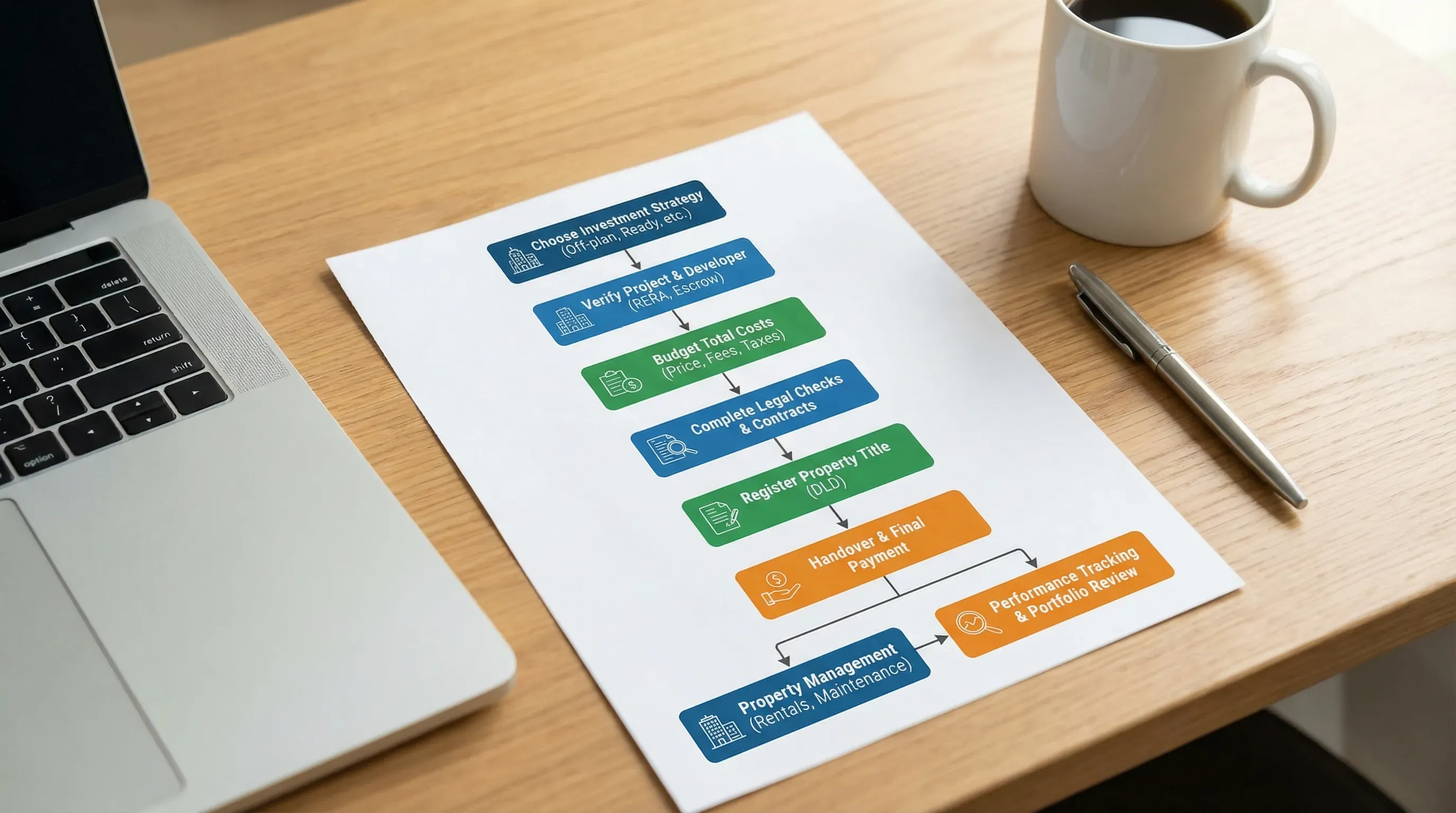
The real-world process: what your purchase journey usually includes
Although terminology differs by emirate and whether you buy ready or off-plan, most UAE property purchases follow a predictable sequence.
In practice, expect:
-
Goal setting and budget boundaries (including a buffer for fees and initial operating costs).
-
Area selection (micro-location matters more than “Dubai vs RAK” headlines).
-
Project and developer screening (track record, escrow usage, delivery quality, resale depth).
-
Unit selection (views, floor, layout efficiency, parking, service charge implications).
-
Reservation and paperwork (ID, proof of address, source-of-funds support where required).
-
Contract review (Sale and Purchase Agreement for off-plan, or MoU style documentation for resales, plus any addenda).
-
Registration steps (varies by emirate; off-plan commonly involves interim registration mechanisms).
-
Handover and operations (snagging, utilities activation, furnishing decisions, leasing strategy).
The key point for beginners is this: UAE property is not complicated when the transaction is clean, but it becomes stressful when you are trying to fix due diligence gaps after money has moved.
Budgeting properly: costs most first-time buyers forget
A purchase price is only the headline number. The UAE is generally straightforward on annual property taxation compared with many countries, but transaction and operating costs still matter.
Cost categories to model (at minimum):
-
Land department registration and admin fees (varies by emirate).
-
Brokerage fees (if applicable).
-
Mortgage-related fees (if financing, including bank fees and mortgage registration charges).
-
Service charges (especially important in managed, waterfront, or amenity-heavy communities).
-
Insurance and maintenance (including sinking-fund style reserves for replacements).
-
Letting costs (leasing commission, marketing, minor refurb between tenants).
If you are investing in RAK specifically, Azimira’s ROI and net-yield breakdown is helpful because it forces you to account for the full cost stack: How to Project Your Real Estate ROI: A Comprehensive Guide to Calculating Tax-Efficient Yield in the UAE.
Due diligence: how to reduce your downside before you sign
In a fast-moving market, “good opportunities” are often presented with urgency. Your job as an investor is to slow down the right parts of the process.
Focus on verifying four areas:
1) Counterparty legitimacy
Confirm the broker is licensed, confirm the developer is properly registered for the project, and ensure you understand who is actually receiving payments and under what structure.
Azimira’s scam-prevention checklist is worth reading even if you feel confident: 4 Red Flags That Scream Property Scam in the UAE.
2) The asset’s “true comparables”
Do not rely on the best-looking listing in the tower or a single quoted yield. Check:
-
Recent achieved rents (not just advertised rents)
-
Competing supply coming online nearby
-
Service charges and what they include
-
Unit-specific liquidity factors (layout, view corridor risk, parking, proximity to lifts and noise sources)
3) Contract clarity
You want to understand, in plain English:
-
Payment milestones and what triggers them
-
Default clauses and late payment consequences
-
Handover definition and what counts as completion
-
Defects liability and warranty language
-
Assignment and resale rules (especially for off-plan)
4) Operational readiness
If you are buying for income, map out the first 90 days after handover or transfer:
-
Utilities setup and approvals
-
Furnishing decision (if applicable)
-
Marketing plan and tenant screening
-
Property management scope and fees
Managing your investment from abroad (without it becoming a second job)
International owners often underestimate the operational side. Remote investing can work well in the UAE, but it works best when the “plumbing” is set up early.
That typically includes:
-
Banking suitable for receiving rent and paying service charges
-
Clear payment pathways for staged off-plan instalments
-
A property manager with defined KPIs and reporting cadence
-
A compliance folder (contracts, receipts, registration docs, warranty docs, inventory list)
If you expect to manage the process remotely, this guide is a practical companion: 5 Ways to Buy RAK Property Without Leaving Your Country.
A simple 30-day starter plan (what to do next)
If you want momentum without rushing into the wrong unit, aim for controlled progress:
-
Week 1: Define your objective (income, growth, balanced, lifestyle, residency) and your maximum all-in budget.
-
Week 2: Choose one emirate and two target communities, then study them at micro level (supply pipeline, tenant profile, amenities, access).
-
Week 3: Compare 3 to 5 projects with a consistent template (developer record, handover timeline, service charges, exit liquidity, realistic rent ranges).
-
Week 4: Shortlist units, run a conservative net-return model, and only then begin reservation discussions.
This process is deliberately boring. Boring is good in property investing.
How Azimira can help you invest with fewer blind spots
Azimira specialises in connecting investors and buyers with premium off-plan opportunities in the UAE, with a strong focus on high-growth markets such as Ras Al Khaimah. If you want help turning a broad interest in real property investment in the UAE into an executable plan, the value is usually in:
-
Curated projects matched to your objective (income, growth, or lifestyle)
-
Market insight and timing guidance, including pre-launch access where available
-
Support across due diligence, documentation, and a practical end-to-end purchase plan
To explore current opportunities and get specialist input on which areas and projects match your investment thesis, visit Azimira.
Related articles
Test Article from BlogSEO
Test Article from BlogSEO

What to Expect from a Property Partner in the UAE
What to expect from a property partner in the UAE: services, due diligence, off-plan support, fees, red flags, and questions to ask before you buy.

How to Compare Investment Returns on UAE Property in 2026
Compare investment returns on UAE property in 2026: net yield vs IRR, true costs, off-plan vs ready, and a practical framework to choose confidently.