Capital Growth in RAK: The Drivers Behind the Next Upswing
Explore the drivers of capital growth in RAK, from branding and infrastructure to supply dynamics. Learn what to monitor before the next upswing.
Ras Al Khaimah (RAK)!!!!!! has moved from “emerging” to “institutional radar” in a remarkably short time. But the most important question for investors in 2026 is not whether RAK is growing. It is what will drive the next upswing in capital growth, and how to position before it is fully priced in.
This article breaks down the drivers that typically sit behind the second leg of an upswing, when a market transitions from early momentum to broad-based demand and deeper liquidity.
Why the next upswing looks different from the first
In most high-growth property markets, the first lift is sparked by a clear catalyst (a mega-project announcement, a tourism push, a regulatory change). The next lift is usually more powerful and more durable, but it is also harder to spot because it comes from stacked drivers:
-
Demand expands from one buyer type to multiple buyer types.
-
Product quality improves, which resets price anchors.
-
Financing, resale liquidity, and professional management mature.
-
Global attention increases, which compresses “risk discounts”.
For RAK, that transition is the story to watch.
Driver 1: RAK’s demand stack is widening (not just tourism)
Tourism matters in RAK, particularly for waterfront and resort-adjacent assets, but tourism alone rarely sustains multi-year capital growth. The durable upside tends to come when the buyer and tenant base diversifies.
In RAK, the demand stack is broadening across four overlapping groups:
-
Lifestyle buyers who want coastal living, outdoor access (including mountains), and a calmer pace than Dubai.
-
Yield-focused investors targeting net income and long-horizon appreciation.
-
Second-home and holiday buyers who value serviced formats and turnkey management.
-
Relocation-driven residents (including entrepreneurs and remote workers) attracted by cost, space, and improving amenities.
As these cohorts overlap, markets typically see:
-
Faster absorption at launches
-
Stronger resale depth (more end buyers)
-
A shift from price-led buying to quality-led buying (important for valuation expansion)
That is a classic setup for the next phase of capital growth.
Driver 2: Placemaking and global branding effect (RAK’s “re-rating” mechanism)
The fastest way a market’s pricing resets is when it becomes legible to global buyers. In property, that often happens through placemaking (destination-scale projects) and global brands that reduce perceived risk.
RAK’s flagship narrative here is the integrated resort on Al Marjan Island by Wynn Resorts, which has been publicly announced and is expected to open in 2027. You can read Wynn’s project announcement via the official release on the Wynn site: Wynn Resorts’ Al Marjan Island project information.
Two additional dynamics amplify this branding effect:
-
The UAE’s formal gaming regulator (the General Commercial Gaming Regulatory Authority, established in 2023) adds institutional structure and visibility. The regulator is described on the UAE government portal: GCGRA overview.
-
Branded residences and hospitality-led living shift the market’s comparables. Once branded product becomes a meaningful part of supply, it tends to pull up nearby standard inventory through new price anchors.
The practical investor takeaway is simple: the next upswing is often fuelled by re-rating, not just organic growth. Re-rating happens when buyers stop comparing RAK only to the northern emirates and start comparing it to lifestyle destinations across the UAE.
Driver 3: Connectivity and friction reduction (time is value)
A market can have strong fundamentals and still underperform if it feels “hard” to access. The next leg of capital growth often arrives when friction drops:
-
Improved road access and internal connectivity
-
More flight options and smoother airport experience
-
Higher quality retail, dining, healthcare, and schooling (reducing the need to “go to Dubai”)
-
Clearer pathways for remote purchase and ownership operations
Even when the headline is a future infrastructure project, the price impact frequently starts earlier, because developers, employers, and end users adjust behaviour in anticipation.
One note of caution: national rail initiatives are frequently discussed in the region, but timelines for passenger rail services can evolve. Investors should treat rail-related upside as optionality unless and until dates and station locations are confirmed.
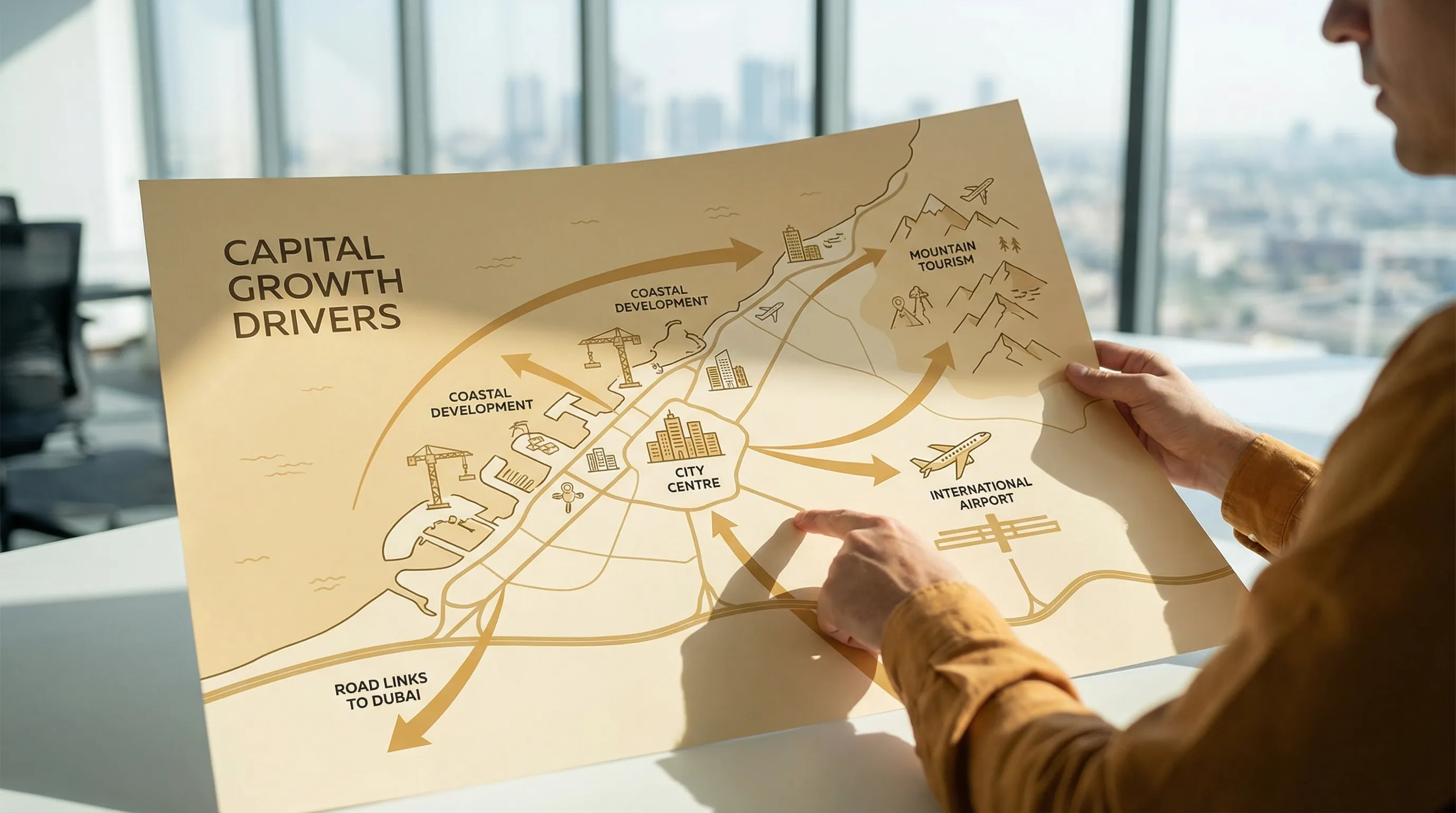
Driver 4: Supply discipline and phasing (the hidden determinant of appreciation)
In high-growth off-plan markets, capital growth is often less about “how much is being built” and more about how supply is phased relative to demand.
When supply is well-sequenced, prices can climb even with meaningful construction activity, because:
-
Inventory releases are timed to absorption
-
Amenities arrive in sync with handovers
-
Developers protect pricing integrity (fewer discounts needed)
When supply is poorly sequenced, appreciation can stall even with strong tourism headlines.
What to monitor (a simple investor dashboard)
You do not need perfect data to make good decisions, but you do need the right indicators. Here is a practical way to track whether the market is setting up for the next upswing.
| Indicator | What “healthy” looks like | Why it matters for capital growth |
|---|---|---|
| Launch absorption | Strong early reservations without heavy discounting | Signals depth of end demand, not just speculative flow |
| Resale liquidity | More genuine end-buyer activity, fewer forced exits | Supports price discovery and reduces volatility |
| Incentive intensity | Incentives exist but do not expand every quarter | Rising incentives can be an early oversupply flag |
| Rent vs price movement | Rents and prices rise together (not diverging sharply) | Helps confirm demand is real and sustainable |
| Handover quality | Fewer snagging disputes, stronger finishing consistency | Quality reduces “risk discount” at resale |
Driver 5: Policy and capital flows (the macro tailwind behind micro pricing)
RAK’s property upside sits within a broader UAE investment context that matters for international capital allocation.
Key structural elements include:
-
Currency stability: the UAE dirham’s long-standing peg to the US dollar reduces currency uncertainty for many investors, especially those with USD-linked liabilities.
-
Residency pathways: the UAE’s long-term residency options, including property-linked routes (often discussed around the AED 2 million level for a 10-year visa), can convert investors into end users, which supports deeper demand.
-
Business formation and relocation: RAK’s wider ecosystem (including free zones) helps create resident demand that is not purely tourism-led.
Macro conditions still matter, particularly global rates and risk appetite, but the presence of these structural elements can make down-cycles shorter and recoveries faster than in many other emerging markets.
Driver 6: Product evolution (why “new supply” can raise prices)
Investors often worry that new projects mean more competition. Sometimes they do. But in a market that is upgrading, new supply can increase surrounding values because it changes what buyers expect.
In RAK, the product evolution theme includes:
-
More hotel-style living formats (serviced, managed, short-stay capable)
-
Better community masterplanning (walkability, retail integration, waterfront activation)
-
Higher finishing standards and smarter layouts (important for resale)
-
Sustainability and efficiency features that reduce running costs (which can improve net yields)
When these features become normal rather than exceptional, they reshape valuation. That is another mechanism behind capital growth.
Driver 7: Distribution and attention (demand is also a marketing function)
In the early stage of a market, demand can be driven by a small set of channels: developer databases, broker networks, and local referrals.
As a market matures, distribution scales. Attention becomes global, and deal flow accelerates.
For buyers, this matters because wider distribution increases competition for the best units (view lines, stack positions, corner layouts, scarce inventory). For advisors, it matters because lead response time and follow-up discipline start to affect allocations.
If you run an investor network, consultancy, or brokerage and want to systemise outreach (particularly on social channels where many cross-border buyers begin), tools like Orsay can automate prospecting and follow-up so that qualified conversations happen faster.
How to position for the next upswing (three capital growth styles)
The “right” strategy depends on what kind of capital growth you are targeting: early repricing, construction-phase uplift, or liquidity-driven appreciation.
| Strategy | Typical entry point | Why it can work in RAK | Primary risk to manage |
|---|---|---|---|
| Early-phase off-plan | Pre-launch or early launch | Maximum pricing inefficiency, strongest unit selection | Developer execution, timeline slippage |
| Mid-cycle near handover | Late construction to handover window | Reduced delivery risk, still captures re-rating | Less discount available, more competition |
| Ready, proven communities | Completed assets with track record | Clear rental evidence and resale comparables | Lower upside, pricing can be closer to “fair value” |
A common mistake is treating capital growth as a single number. In reality, it is a mix of timing, product, and liquidity.
What could interrupt the upswing (and how experienced investors respond)
No growth story is one-way. The disciplined approach is to assume upside, but underwrite the risks.
Here is a practical risk map you can use when evaluating opportunities:
| Risk | How it shows up | Practical mitigation |
|---|---|---|
| Oversupply in a micro-location | Incentives rise, resales take longer | Focus on scarcity attributes and phased masterplans |
| Construction delays | Handover pushes out, cash flow timing shifts | Prioritise strong delivery track records, align payment plan with buffer |
| Quality mismatch | Finished product does not match positioning | Demand clear specs, review prior handovers, snag professionally |
| Global risk-off cycle | Buyer sentiment softens temporarily | Favour assets with genuine end-user appeal and strong rental depth |
The key point: investors capture the next upswing by choosing the right micro-market and asset, not by assuming the entire emirate moves uniformly.
Where Azimira fits if you want to act, not just research
The next phase of capital growth in RAK is likely to reward buyers who combine market timing with selectivity: strong developers, launch access, and unit-level diligence.
Azimira focuses on connecting investors and buyers with curated off-plan opportunities in the UAE, with a particular emphasis on high-growth markets like Ras Al Khaimah. If you want a strategy-led approach (rather than browsing listings), Azimira can support with market insight, tailored investment planning, and access to premium launches.
You can explore Azimira at Azimira.
Related articles
Test Article from BlogSEO
Test Article from BlogSEO

What to Expect from a Property Partner in the UAE
What to expect from a property partner in the UAE: services, due diligence, off-plan support, fees, red flags, and questions to ask before you buy.

How to Compare Investment Returns on UAE Property in 2026
Compare investment returns on UAE property in 2026: net yield vs IRR, true costs, off-plan vs ready, and a practical framework to choose confidently.